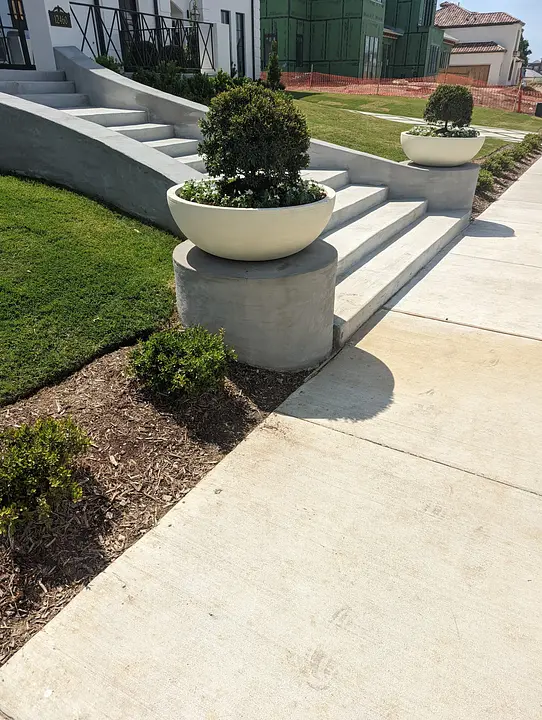
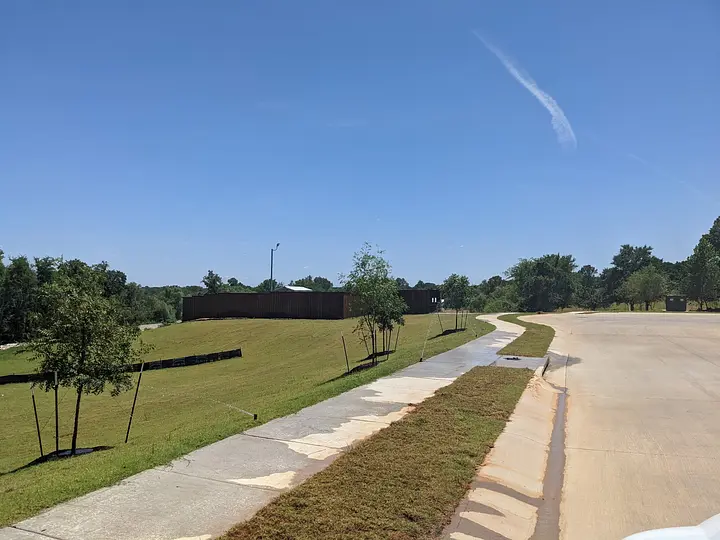
Patios, walls, walkways and fire features — built on a base that will not move.
Turf and beds are what a yard looks like. Hardscape is what you stand on, sit on and cook on. It is also the part that either lasts twenty years or starts sinking in three — and which of those happens is decided before a single stone is laid.
Blackland clay swells after rain and shrinks hard in an August drought. A patio built on it without a properly excavated, compacted and drained base will move, because the ground under it moves. Almost every failed patio we are asked to look at failed underneath, not on top.
We build the base, the drainage and the grading as part of the job, and our own crews do the work. That is why we are comfortable talking about what is under your patio as much as what is on it.
Request an estimate
Outdoor living space sized to how you actually use it — a table and chairs needs more room than people plan for. Laid on a compacted base with proper edge restraint so it stays flat.
Front walks, side paths and stepping-stone routes through beds. Width and surface chosen for whether it is a route or a stroll.
Segmental block or stone, engineered for the load and drained behind. A retaining wall that cannot drain is a retaining wall waiting to lean.
Low walls that double as seating around a patio or fire pit — more usable than furniture, and they never blow over in a North Texas storm.
Built-in gas or wood fire pits with proper clearances and a seating layout designed around them. The single feature that gets a back yard used in winter.
Grill islands, counter runs and storage, built to take the weather. Utilities coordinated so the gas and power are where they need to be before we build over them.
Set stone, boulder groupings and stone steps, used for grade changes and as focal points where a wall would be too formal.
Steel, stone and concrete edging that keeps beds and turf where they belong. Unglamorous, and the difference between a landscape that looks maintained and one that does not.
Informal paths and seating areas, correctly stabilised and edged so they do not migrate into the lawn with every rain.

This is the part nobody sees, nobody asks about at bid time, and everybody notices four years later.
Topsoil and existing material stripped out properly. Building on undisturbed, prepared subgrade rather than on top of whatever was there is the first thing cheap installs skip.
Crushed aggregate laid in layers and compacted each time. A thick base dumped in one go and rolled once is not a compacted base, whatever it looks like.
Slope set to move water away from the house, and drain lines tied in where the site needs them. On clay this is not optional — water trapped under a patio is what lifts it.
A thin, even setting bed screeded flat. Thick sand beds are a shortcut that shows up as ruts and dips within a couple of seasons.
Pattern laid to a string line, cuts made cleanly at the perimeter, and edge restraint installed so the field cannot creep outward.
Joint sand swept in and vibrated home, so the surface locks together and behaves as one piece instead of a collection of loose stones.
Every square foot of hardscape is a square foot that no longer absorbs rain. Put four hundred square feet of patio against a house without thinking about it and you have created four hundred square feet of new runoff — usually heading somewhere you do not want it.
We design the drainage with the hardscape rather than after it: slope away from the structure, drains where the water now collects, and where necessary a system that takes it somewhere sensible. Getting this wrong is how a beautiful patio turns into a standing-water complaint and, eventually, a foundation conversation.
There is no single best material. There are trade-offs, and the right answer depends on where the surface is and what you want from it.
Consistent, strong, huge range of styles, and individually replaceable if one is ever damaged. The workhorse for patios and drives, and the easiest to keep flat over time.
Natural stone, irregular and characterful. Beautiful for informal patios and paths. More labour to lay well, and thickness varies, so the base work matters even more.
Cooler underfoot than many surfaces in full sun, which is a real consideration around a pool in a Texas July. Softer than concrete and worth understanding before choosing.
Informal, permeable, inexpensive, and the right answer for a garden path or a casual seating area. Needs stabilising and edging or it wanders.
Tell us how you want to use the space and we will design it, price it and build it.
Not if the base is built for it. Clay moves seasonally, so the answer is proper excavation, a compacted aggregate base and drainage that keeps water from sitting underneath. Where you see sunken pavers, you are almost always looking at a base problem rather than a paver problem.
Concrete is cheaper up front on a large plain slab. Pavers flex slightly with ground movement instead of cracking, can be lifted and re-laid if anything ever needs access underneath, and one damaged unit can be swapped rather than patching a slab. On expansive clay that flexibility counts.
Bigger than people first draw. A table with chairs that can actually be pushed back needs a surprising amount of room, and a fire pit needs seating clearance all the way round. We lay it out on the ground before pricing so you can stand in it.
Yes, and it needs doing deliberately — heads relocated, lines re-routed or sleeved before anything is built over them, and zones adjusted for the turf that is no longer there. Because we hold the irrigation licence in house that is part of the same job, not a second contractor.
We coordinate them so the rough-in is in the right place before we build. Licensed gas and electrical work is done by the appropriate licensed trades — we make sure it happens in the right order rather than after the stone is set.
Most residential patios are a matter of days rather than weeks once we start, but the base work is the part that cannot be rushed and weather moves things. We give you a real schedule, not an optimistic one.
Tell us about the space, roughly how big, and how you want to use it. We’ll follow up to arrange a walk-through.
Prefer to talk? Call (972) 240-8082, Monday to Friday, 8:00 AM to 5:00 PM.