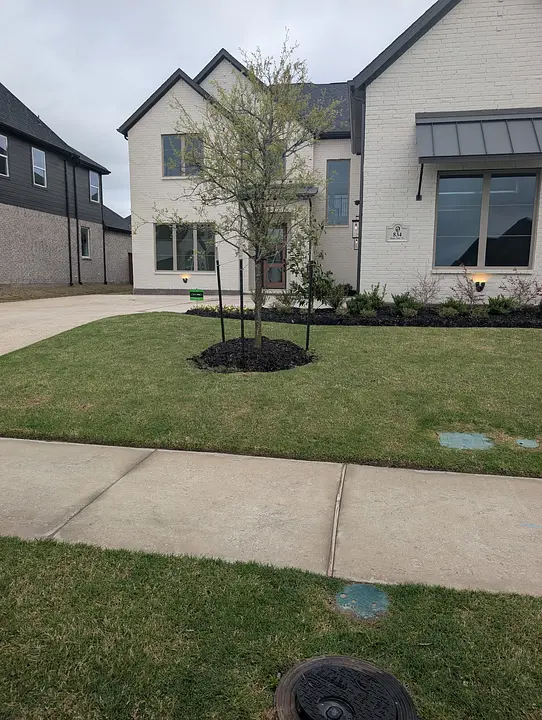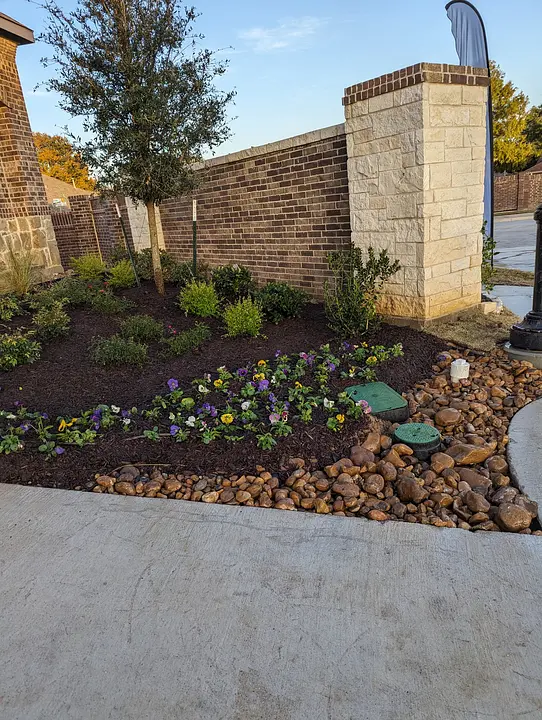
Designed and installed by us — safer paths, longer evenings, and a house that looks its best after dark.
Think about when you are actually at your house. Most of the year, you leave in daylight and come back to a yard you cannot see. The landscape you paid for is invisible for most of the hours you are there to enjoy it.
Lighting is the cheapest way to get more out of everything else in the yard. It roughly doubles the hours a patio is usable, it makes steps and paths safe to walk, it makes a house look considerably more expensive from the street, and it removes the dark corners that make a property feel unwatched.
We design and install low-voltage systems ourselves — the layout, the transformer, the wire, the fixtures and the controls.
Request an estimate
Uplighting on columns, gables, stone and architectural detail. This is the one that changes how the property reads from the street, and it is usually the first thing people notice.
Uplighting from below for drama, or moonlighting — fixtures mounted up in the canopy throwing dappled light down through the branches. Moonlighting is the most natural-looking effect available and almost nobody does it.
Not a runway of identical lights every six feet. Enough light, placed where the ground actually changes level, so people can see where to put their feet.
Low, warm, glare-free light around seating and cooking areas so the space is usable after dark without feeling like a car park.
Grazing across a wall to bring out its texture, and accents on specimen plants, water features and stonework so the landscape has depth at night rather than a black backdrop.
Making the front door obvious, the house number readable and the drive edge visible — the practical half of the job, and the half guests notice when it is missing.
It is almost never the fixtures. It is where they are aimed and how many there are.
You should see a lit tree, not a bright light with a tree behind it. Fixtures get tucked into beds, shielded and aimed so the source itself is out of view from where people stand and sit.
The commonest mistake in residential lighting is too many path lights spaced evenly down a walk. It reads as an airport runway. Light the changes — a curve, a step, a corner — and let the rest fall away.
Warm white throughout, around 2700K, looks like lamplight. Mixing warm and cool fixtures across a front elevation is the single most obvious sign of a system that grew by accident.
Aim away from the front door approach, away from seating sightlines, and away from bedroom windows. A fixture that makes you squint has failed no matter what it is illuminating.
A little light on the house, a little in the trees, a little at ground level. Depth comes from several modest layers, not from one bright wash.
Plants get bigger. Fixtures get set back far enough and on enough wire that a shrub filling in does not bury the light two years later.
Fixtures and wire get set back from mowing and edging lines. The most common cause of a dead light on a maintained property is a mower or a trimmer, not the fixture.
Tell us what you would like lit and we will design a layout and price it.
No, and most people should not. A front elevation and a couple of trees transforms the kerb appeal for a fraction of a whole-property system. We design the full layout and size the transformer for it, then install in stages if you would rather.
LED landscape lighting draws very little — a whole residential system is typically comparable to a couple of household bulbs. Running it on a timer or an astronomic control rather than dusk-to-dawn trims it further.
Low-voltage cable is buried shallow, routed through beds where possible and kept clear of the lines a mower and edger follow. Where it has to cross turf, it goes deep enough to be out of the way of aeration and normal maintenance.
If we are already opening ground for irrigation or drainage, running lighting cable at the same time saves labour and disruption. If you are considering both, doing them together is genuinely cheaper than doing them a year apart.
Tell us what it is doing and we will tell you honestly whether it is worth repairing or whether you are better off replacing it. Dim yellow fixtures at the end of a run usually mean undersized wire, which is a design problem rather than a fixture problem, and that changes the answer.
Fixtures mounted high in a tree, aimed down, so light filters through the branches and casts leaf shadows on the ground. It looks like a full moon through the canopy. It is the most natural effect in landscape lighting and it is remarkably rare in this market.
Tell us about the property and what you would like lit — the house, the trees, a patio, or all of it.
Prefer to talk? Call (972) 240-8082, Monday to Friday, 8:00 AM to 5:00 PM.