Freeze damage is invisible until you turn the water back on. Inspect first, pressurise slowly.
Our winterization guide covers what to do before a freeze. This is the other half: what to check afterwards, and in what order.
The important thing to understand is that freeze damage to an irrigation system is almost always invisible while the water is off. A cracked backflow assembly looks completely normal until it is pressurised — at which point it becomes a fountain, sometimes an expensive one, sometimes at three in the morning.
So the rule is simple: inspect before you pressurise, not after.
Not the first sunny afternoon in the middle of a cold snap. Wait until night-time temperatures are reliably above freezing, because turning water back into a system and then refreezing it does more damage than the original event.
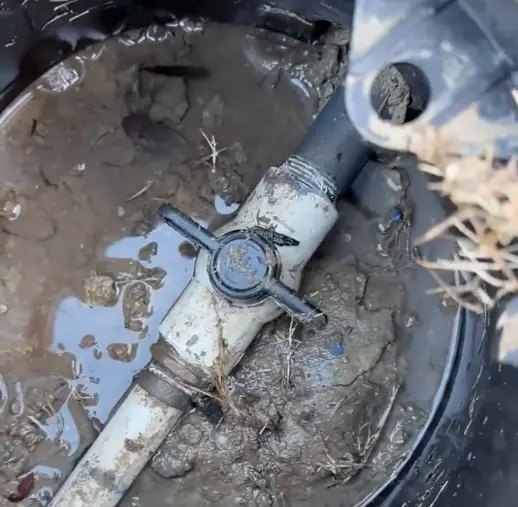
This is the most common casualty by a wide margin — it is brass, it is above ground, and it holds water. Look for a split in the body, a cracked bonnet or test cock, a bulge, or a hairline you can catch with a fingernail. Brass splits along a seam when the water inside it expands.
Any above-ground pipe, the riser up to the backflow, and anything in a shallow or uninsulated valve box. Look for splits, and for fittings pushed apart.
Open the main irrigation valve slowly rather than all at once, and watch and listen. Do not walk away. If something is cracked, this is the moment you find out, and you want your hand on the valve when you do.
Watch the whole zone run. You are looking for heads that do not rise, new wet patches, geysers where a head has split, and pressure that is noticeably down on what it was.
Once you are done, turn everything off and read the water meter, then read it again two hours later. Movement means something is leaking underground that you cannot see.
By far the most common, and the most expensive small part in the yard. Brass cracks when water inside it freezes and expands. Often it looks perfect until pressurised.
Anything above ground or barely below it. PVC splits lengthwise, and the split can be fine enough to miss until there is pressure behind it.
Shallow boxes that filled with water and froze. Cracked bonnets and split solenoids show up as a zone that will not run or will not shut off.
Water left standing in a head can crack the body. Usually cheap to fix, and usually only found by running each zone and watching.
A hose left attached over a freeze keeps water sitting in the bib. That failure often shows up inside the wall rather than outside, which is why it is worth checking.
Same failure, much bigger consequence. On managed properties we shut systems down ahead of a freeze remotely, which is one of the quieter benefits of remote water management.
The instinct after a freeze is to tidy up the brown. Resist it for a few weeks.
Freeze damage is one of the few landscape problems that is almost entirely avoidable with an afternoon of preparation.
Shutting down, draining and insulating — step by step, before the first hard freeze.
Read the guide →Cracked backflow, split lines and valves that will not close. We do this work year round.
Irrigation repair →Send a repair request through the residential portal and it gets logged and routed.
Submit a request →Managed properties get shut down remotely ahead of a freeze rather than by a truck roll.
Grounds maintenance →Freeze repairs are what we do in January. Tell us what you found.
Once night-time temperatures are reliably above freezing, not on the first mild afternoon of a cold snap. Refilling a system and then refreezing it causes more damage than the original freeze.
Not necessarily. Cracks in brass are often hairline and invisible until the assembly is pressurised, which is exactly why you should open the main valve slowly and stay next to it rather than turning it on and going indoors.
Not yet. Damaged growth protects the crown from the next freeze, and a lot of what looks dead in January comes back from the base in spring. Wait until you can see new growth, then prune back to it.
Almost certainly not. Warm-season grasses in North Texas go brown every winter as a matter of course. Judge the lawn after spring green-up, not during dormancy.
Very possibly. A split lateral line loses pressure to the ground rather than to the heads, and it can be subtle. Run the zone and walk it looking for a soft or unusually green patch.
Yes — it is a large share of what we do in January and February. If you would rather not open the valve yourself and find out the hard way, that is an entirely reasonable position to take.
Tell us what you found and whether the system has been turned back on yet.
Prefer to talk? Call (972) 240-8082, Monday to Friday, 8:00 AM to 5:00 PM.