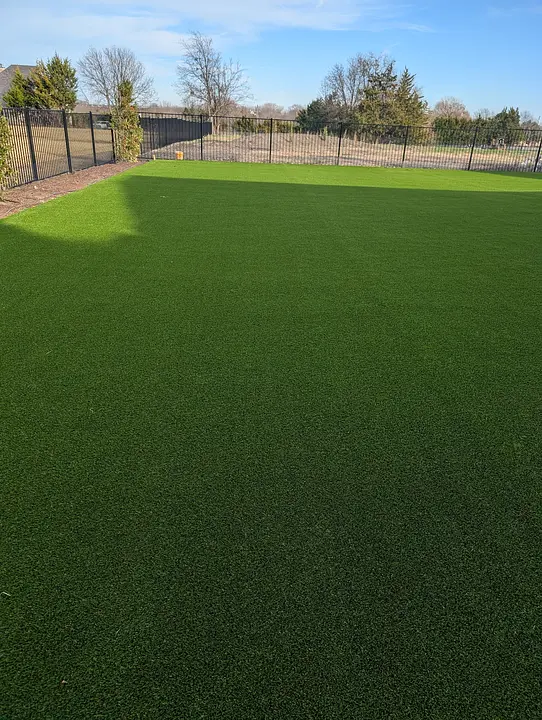
Green every day of the year — in the shade, in the dog run, and on your own back yard putting green.
Deep shade under a mature tree. The strip beside the house that gets four hours of light. The run where the dog has worn a permanent path. A slope that erodes faster than it establishes. A pool surround that is either wet or dusty.
People fight those areas for years — resodding, reseeding, adding fertiliser, adding water — and lose, because the problem was never fertility or water. Synthetic turf ends the argument. It is green in February, green in the fourth week of a burn ban, green in shade where nothing else will grow, and it does not care what your city’s watering days are.
We design and install synthetic lawns, pet areas and backyard putting greens across the Metroplex.
Get a synthetic turf quote
Through August heat, through a drought stage, through a hard freeze, and through the six weeks in late winter when every real lawn in the neighbourhood is brown.
Two days a week, one day a week, a total outdoor ban — none of it changes how the yard looks. On a property where the water bill is a real number, that is the argument that closes it.
No Saturday mornings, no fertiliser rounds, no pre-emergent timing to miss, no mower to service. The maintenance is a rinse and an occasional brush-up.
The one thing no real grass can do. Under a mature oak, on the north side of a two-storey, in a courtyard that gets an hour of sun — synthetic does not need light.
Built on a compacted, draining base, it sheds water fast. No mud tracked through the house, no ruts from walking on saturated turf.
No bare patches, no holes, no uneven ground. For kids, for dogs, and for a putting surface, consistency is the whole point.
Dog owners in North Texas know the cycle: the worn path along the fence, the dead yellow circles, the mud that becomes indoor mud, and the reseeding every autumn that lasts until the dog notices.
It is one of the most common reasons people call us about synthetic turf, and one of the easiest to be happy with afterwards.
It is far more achievable than most people assume, and it is the project homeowners enjoy most once it is in.
Multiple cup positions so the same green plays differently, and contours shaped into the base so putts actually break. A flat rectangle of green turf is a rug; a shaped green is practice.
Putting surfaces use a short, dense pile with sand infill. How much infill goes in, and how tightly it is brushed, sets the roll speed — we set it to how you want it to play.
A collar of longer turf around the green, and an approach area if there is room, so you can practise chip-and-run shots and not just putts.
Most residential greens we look at are modest — tucked into a corner, wrapped around existing beds. You do not need an acre to get something worth using.
Greens are usually combined with a synthetic lawn area, so the same install serves golf, kids and dogs without three different surfaces.
No mowing at a hundredth of an inch, no top dressing, no rolling. It plays the same in July and in January.
The turf is the part you see and the least likely thing to go wrong. Bases sink, drain badly and grow weeds — and that is an install problem, not a product problem.
Existing turf and soil are stripped to depth. Skipping this is why cheap installs settle into dips within a year.
Crushed aggregate laid in lifts and compacted properly, shaped to drain. On a putting green, this is also where the contours are formed.
The base drains through, and where the site needs it we tie into a drain line. In blackland clay that step is not optional — water has to have somewhere to go.
A barrier layer between base and turf so nothing comes up through the seams later.
Turf rolled in a consistent grain direction, seams glued and nailed so they disappear, edges anchored down so nothing lifts at a corner.
Infill brushed in to hold the blades upright, protect the backing from UV, weight the turf down and — on a green — set the roll speed.
We install both, so we have no reason to oversell either. Synthetic is the right answer for a lot of areas and the wrong answer for some:
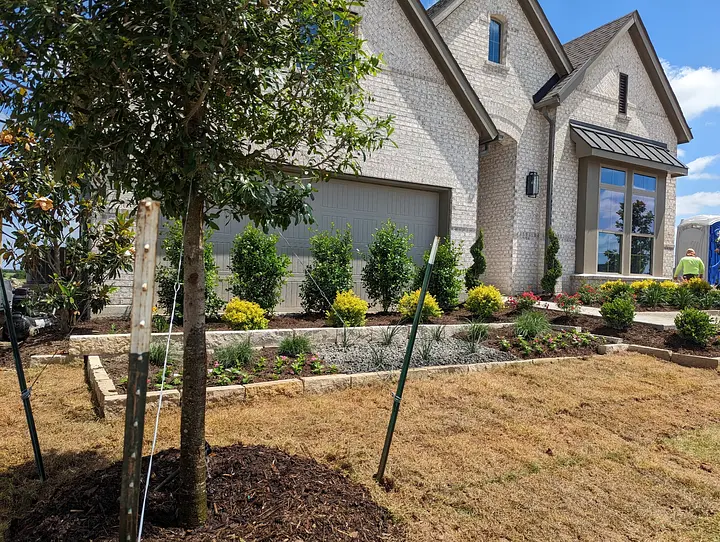
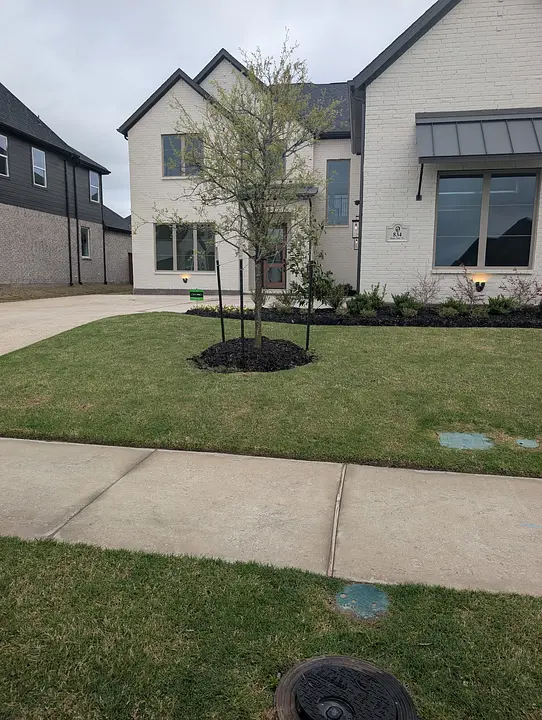
Which is why most of the properties we do end up a mix: real turf where it thrives and gets used, synthetic where it never had a chance.
Send us the area and we will tell you honestly whether synthetic is the right answer for it.
Quality turf on a properly built base is a long-term installation measured in many years rather than seasons, and most manufacturers back their turf with a warranty. The base is what determines whether you get the full life out of it, which is why we spend most of the install below the surface.
Yes, and pet areas are one of the most common installs we do. The details that matter are a free-draining base and an infill chosen for odour control, plus a hose-down routine. Waste rinses through rather than sitting on top.
It drains through the backing into the base and away. How well depends entirely on how the base was built and whether the site drains at all — on clay, we often tie it into drainage rather than assume the ground will take it.
Usually somewhere, sometimes not everywhere. Back yards are rarely an issue; front yards vary a lot by association. Check your guidelines and tell us what they say, and we will design to them.
Smaller than people expect. Most back yard greens are a modest area tucked into a corner with two or three cup positions and a fringe. If you have room for a patio, you have room for something worth practising on.
That is the usual job. Synthetic in the shaded strip or the dog run, real turf where it grows well, and beds around both. Doing the whole yard is the exception, not the rule.
Yes, if you have any live plants left — and the zones will need adjusting so you are not spraying an artificial lawn. That is straightforward for us since we hold the irrigation licence in house.

Tell us which area you are thinking about, roughly how big it is, and what it is for — pets, kids, golf or just an area that will not grow.
Prefer to talk? Call (972) 240-8082, Monday to Friday, 8:00 AM to 5:00 PM.