Your New Build’s First Year

Fresh sod, a young irrigation system and a lot that has not settled yet. The first twelve months decide the rest.

Yard Smarts guide

Congratulations. Your yard is now the least finished part of the house.

A new build in Fate, Royse City, Forney or anywhere else along the growth corridor arrives with fresh sod, a young irrigation system, grading that has not settled, and soil that spent the last year being driven over by trucks.

None of that is a defect. It is simply what a new lot is, and the first twelve months decide whether it becomes a good yard or a permanent maintenance problem. Most of the expensive mistakes happen in the first six weeks.

We install a great many builder yards across this region, so this is the list we would give a friend who just closed.

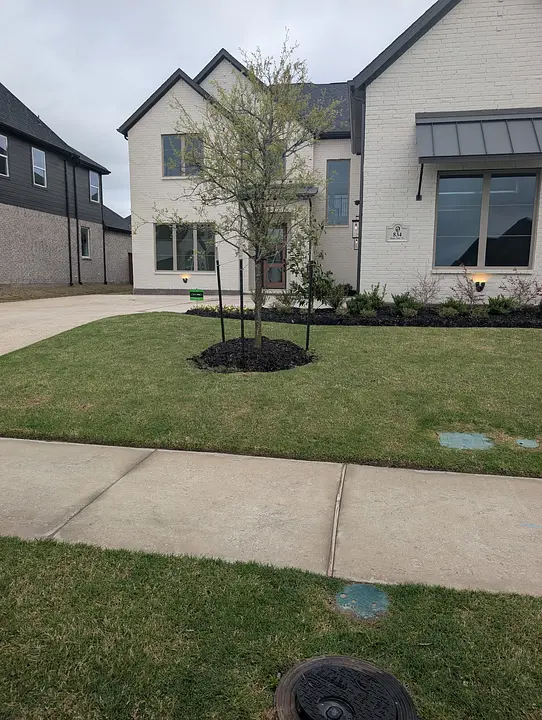
Newly completed North Texas home with fresh landscaping
Weeks one to three

The sod is the urgent part

Everything else on this page can wait a month. This cannot.

Water it far more than feels right

New sod has no root system — it is sitting on the soil, not in it. For the first couple of weeks it needs water most days, sometimes twice on a hot one, to keep the turf and the soil beneath it damp. This is the one time in a North Texas yard when frequent shallow watering is correct.

Then back off deliberately

Once it has knitted down — tug a corner gently, if it resists it has rooted — start extending the interval and lengthening each run. Going straight from daily watering to a normal schedule kills more new sod than drought does.

Stay off it, and mow high the first time

Keep traffic off until it has rooted. When you do mow, take only the top and keep the deck high. Scalping sod that has just rooted sets it back weeks.

Check your watering days first.

Most cities allow a temporary variance for new sod and new landscape — but you generally have to ask. It is worth a five-minute call to the city rather than assuming, or assuming you cannot. Our watering guide links every local page.

Month one

Learn the system you inherited

1Find and label every zone

Run each zone from the controller and walk it. Write down what each one covers — front lawn, side beds, back lawn — and tape the list inside the controller door. Fifteen minutes now saves you and every future technician real time.

2Find the irrigation shut-off valve

Usually a ground box near the water main or backflow preventer. Find it while nothing is wrong. It is the difference between a stuck valve being an annoyance and a stuck valve being a flooded yard.

3Check whether beds and turf share zones

On a fast build they frequently do, and it means one of them is always on the wrong schedule. It is the most common thing worth correcting on a builder system, and it saves water immediately.

4Reprogram it off the handover schedule

The controller is almost certainly still running whatever was set the week the sod went down. Once the sod has rooted, that schedule is wildly wrong — and it will stay wrong until somebody changes it.

5Confirm the rain sensor works

Texas requires new systems to have a rain or moisture shut-off. Confirm yours is connected and functioning while the system is new enough for it to be somebody else's problem if it is not.

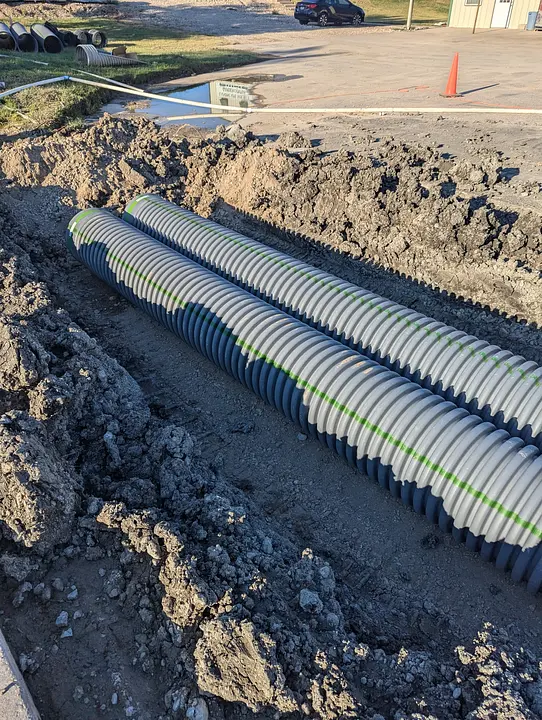
Drainage pipework on a new construction lot
After the first big storms

Watch where the water actually goes

A new lot is graded to a plan. What happens in practice, once the fill settles and the neighbours’ lots are finished, is often different — and you only find out in a real North Texas downpour.

  • Go outside during a heavy rain, once. Genuinely. Five minutes in the wet tells you more about your drainage than any amount of inspection afterwards.
  • Look at the side yards. The narrow strip between closely spaced houses is where new-build water problems concentrate, especially once both fences are up.
  • Check downspout discharge. A downspout emptying against the foundation is common, easy to fix, and worth fixing before it becomes a foundation conversation.
  • Note anything still standing 24 hours later. Puddles that clear are fine. Water that sits is a grading or drainage issue and it will not improve on its own.

Document what you see with photos and dates. If it is a builder issue, that record is what gets it addressed.

Drainage →  ·  Soil moisture and your slab →

Months three to twelve

What settling does, and what to do about it

Heads end up buried

New fill compacts. Heads set flush at final grade end up an inch under it, spraying into turf instead of over it. Raising and re-setting them to grade is routine work and it restores coverage without touching a pipe.

Trenches show as depressions

Lines settle along their runs. Topsoil and re-seed or re-sod the low strips rather than letting them collect water.

New fences change everything

A fence that goes up after the irrigation was designed will block spray patterns and take the overspray. Arcs and nozzles usually need adjusting once fences are in.

Beds get planted after the fact

Anything you add later will not line up with zones designed for the original layout. Converting over-sprayed beds to drip is the fix, and it is cheaper than watching mulch rot.

The warranty conversation

Know what is covered before you need to know

Builder warranties differ, and landscape and irrigation items usually have their own — often short — window. Two things are worth doing in the first month:

  • Find out what the irrigation and landscape warranty actually covers, and for how long. It is rarely the same as the structural warranty and it is frequently much shorter.
  • Report problems in writing, with photos and dates. A phone call to a superintendent is not a record. An emailed note with a photo is.

If your builder uses us, warranty and service requests go through our builder portal and are logged and routed rather than depending on somebody remembering. If they do not, ask your builder who their irrigation contractor is and whether that contractor is TCEQ licensed — you are entitled to know.

And once the builder’s window closes, you can bring anybody in. Plenty of our residential customers came to us that way.

How we work with builders →
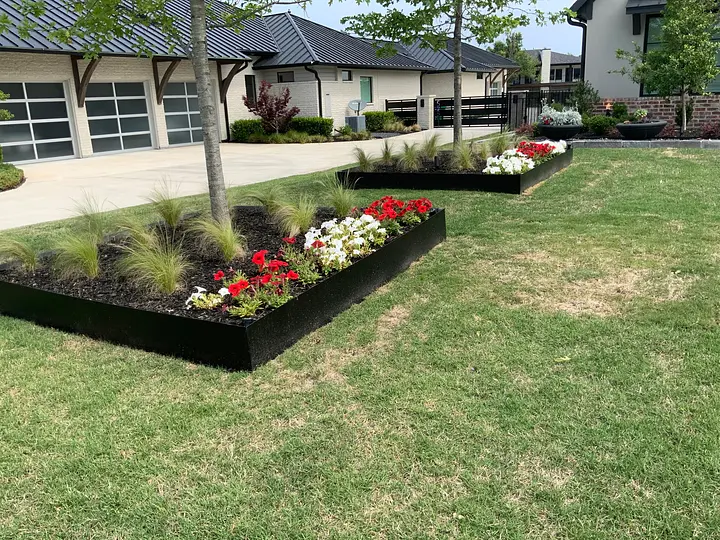
Established beds at a North Texas home
Year one and beyond

When you are ready to make it yours

Builder landscape is a package, not a design. Almost every new-build yard has the same three or four shrubs across the front and nothing else. That is your starting point, not your ceiling.

Just moved in?

We work across Rockwall, Collin, Dallas and Kaufman counties — including most of the new-build corridor.

Let’s talk

Get an estimate

Tell us where you are and what the yard needs. We’ll follow up to arrange a walk-through.

Prefer to talk? Call (972) 240-8082, Monday to Friday, 8:00 AM to 5:00 PM.