Standing Water & Drainage

Why water sits where it does on blackland clay — and what actually moves it.

Yard Smarts guide

Your yard floods because of what is underneath it

Blackland clay does two completely different things depending on how wet it already is, and almost nothing else about drainage here makes sense until you know that.

Dry, it is cracked. Those cracks run from about half an inch to four inches wide at a foot down, and in most years they stay open for three to five months. Rain falling on cracked clay disappears almost instantly — straight down the cracks, often right alongside the house.

Then the clay takes up that water, swells, and the cracks close. Wet blackland clay moves water at roughly six hundredths of an inch an hour. A sandy soil manages more than five inches an hour. That is on the order of a hundred times slower, and it is why the same yard can be bone dry one week and hold water for three days the next. It is not inconsistent. It is one soil in two states.

The practical consequence.

You cannot design around water soaking in here. Anything that depends on infiltration — a dry well, a soakaway, a gravel pit, a dry creek bed built as a soak feature — is a reservoir with no outlet. On this ground, drainage means moving water somewhere on purpose.

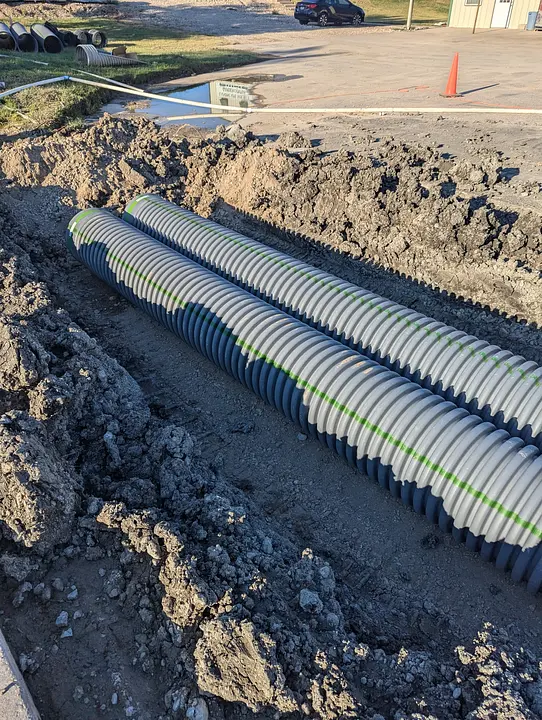
Drainage trench work in North Texas clay soil
Before you spend anything

Work out what you actually have

A good share of the “drainage problems” we get called out to look at turn out to be an irrigation schedule. This sequence costs nothing and takes about a week.

1Does it only happen after rain?

If the wet area appears after a storm and dries up within a day or two, you have a drainage and grading problem. That is the straightforward case, and everything further down this page applies.

2Is it wet whether or not it rained? Turn the controller off.

Shut the irrigation off completely for a week. If the ground dries out, the sprinklers were the cause — a zone running too long, heads overlapping twice on the same strip, or a schedule that never got changed after spring.

3Still wet with the controller off and no rain? Check the meter.

With every tap and appliance in the house off, note the water meter reading, wait two hours and read it again. If it has moved, you have a pressurised leak — either an irrigation mainline or household supply plumbing.

4Meter did not move, but the spot never dries?

Then it is not pressurised water. A sewer line is not under pressure, so a leak in one will not move the meter. That is a licensed plumber’s job rather than ours, and we will tell you so rather than dig a trench next to it.

5Water running off while the sprinklers are on is not a fault.

Clay takes water far more slowly than a sprinkler applies it, so a long single run mostly waters the street. Splitting the same total minutes into two or three shorter cycles with a gap between them fixes it and is free.

Water running off is a scheduling problem, not a drainage problem.

If step five describes your yard, start there before anything else — you may not have a drainage problem at all. The DFW watering guide →

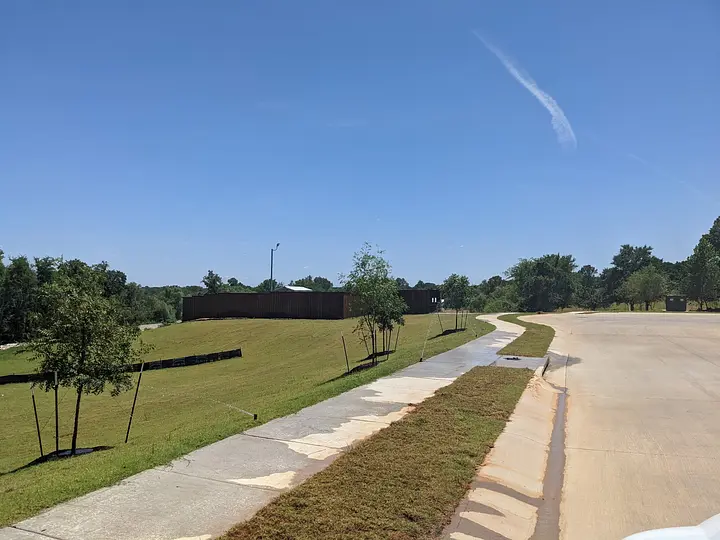
Graded slope alongside a walkway
The one number worth knowing

Six inches in the first ten feet

Residential building code asks that the ground fall at least six inches within the first ten feet away from the foundation — about a five per cent slope. Paving within ten feet of the house should fall away at two per cent minimum.

The part people miss is the exception. Where a lot line, a wall or a slope makes six inches genuinely impossible, the code does not let you simply grade flatter. It requires drains or swales instead. The obligation to get water away from the house does not go away; only the method changes.

And the most common thing we find next to a house with standing water is a grading problem that somebody tried to solve by adding soil. On clay, raising the grade against a wall with nowhere for water to go builds a bathtub — the water cannot go down, so it sits. Two other things worth checking while you are down there: soil should not be covering the weep holes in brickwork, and it should not have crept above the brick ledge.

The options

What works here, and how each one gets done wrong

1Regrading and positive drainage

Reshaping the ground so water leaves on its own. Often the cheapest real fix and always the first thing to check. Done wrong: soil added against the house with no outlet, which raises the grade and traps the water instead of moving it.

2Surface drains — catch basins, area drains, channel drains

A grate at a low point, piped to somewhere the water can leave. On clay this is usually the higher-yield fix, because the problem is nearly always surface water rather than groundwater. Done wrong: the grate set level with or above the surrounding grade so water never reaches it, or not enough fall to the outlet.

3French drains

Perforated pipe in washed stone, for water moving through the soil. Done wrong, three ways: installed to cure surface ponding, which is the wrong tool entirely; laid in clay backfill with no proper stone envelope; or with no fabric separating the stone from the surrounding clay, so fines migrate in and fill the voids.

4The filter sock question — an honest answer

A fabric sleeve on the pipe earns its place in coarse or silty soils. In heavy clay it is at best unnecessary and at worst the thing that blinds off and stops the drain working in year three. What matters is a correctly graded stone envelope around the pipe, with fabric separating that stone from the surrounding soil — not a sleeve on the pipe itself.

5Downspout extensions

The cheapest drainage improvement on most houses, and the one most often skipped. Foundation guidance is to carry roof water at least five to ten feet from the building, or tie the downspouts into a buried line. Done wrong: discharging onto flat clay that drains straight back to the wall, or sending the whole roof to one corner.

6Swales and dry creek beds

A shaped channel with continuous fall along its length — aim for at least two per cent where you can, one per cent as an absolute minimum. Done wrong: a dry creek built as decoration, with no continuous fall and no defined outlet. It becomes a gravel-lined pond. Here, a dry creek bed is a conveyance, never a soak feature.

7Pipe slope — the criterion is velocity

The regional standard used across the Metroplex asks for at least half a per cent fall, or whatever produces about two and a half feet per second running full, whichever is steeper. We deliberately aim above the minimum, because shrink–swell clay moves a buried pipe over the years and a line laid at the bare minimum can end up flat.

8Dry wells — worth saying plainly: not here

A dry well needs the surrounding soil to accept water at roughly a third of an inch an hour to be worth building. Wet blackland clay manages about six hundredths of an inch an hour — around five times too slow, before any safety factor. In this soil a dry well is a buried tank that empties by evaporation.

The bit that turns into an argument

Your neighbour, your plat, and Texas law

Texas Water Code section 11.086 says that no one may divert or impound the natural flow of surface water in a way that damages another person’s property by the resulting overflow — and that an owner whose property is injured has remedies both at law and in equity. That second part matters: a court can order the offending work altered or removed, not only award money.

Three things people get wrong about it. First, it is about altering flow, not about receiving water. Water that has always run across your lot that way is not a violation by anybody. Second, alteration on its own is not the offence — the statute requires the diversion to actually cause damage. Third, impounding counts as much as diverting. Berming up your own low side to keep water out, which is a very common move on a flat clay lot, can make you the one in the wrong by backing water onto the neighbour uphill.

Pull your plat before you touch a side yard. Drainage easements are recorded, and the shallow swale between two houses is very often carrying more than your own roof. Filling it, fencing across it or planting it up is a different kind of problem from a disagreement with a neighbour.

Permits: cities differ, so ask yours.

Dallas lists installation of storm water drains for single- and two-family homes among the work that does not need a permit; Fort Worth runs a grading permit process and publishes no equivalent blanket exemption. Whatever your city says, an exemption will not cover a retaining wall over four feet, work inside a recorded drainage easement, or anything in a floodplain.

Why this matters more here than elsewhere

Drainage and your foundation are the same conversation

Engineering guidance on expansive clay is consistent on one point: uniformity is what matters. Uniform soil moisture, maintained the same way all the way round the house. The damage does not come from the ground moving — it comes from one part of it moving differently from another.

Water ponding at one edge of a slab is the definition of non-uniform. And on soil that cracks four inches wide to a foot deep, ponded water does not merely sit on top — it runs down those cracks to the soil the house is actually bearing on.

Trees are the other half of it. Engineering guidance puts broadleaf trees such as oak, ash, pecan and hackberry no closer to a foundation than their own height, and conifers no closer than the radius of their canopy. Plenty of established lots here do not meet that and never will; treat it as the standard for deciding where to plant something new, not as a reason to take out a mature tree. In a drought, water trees well away from the house rather than close to it.

Foundation watering and drip systems
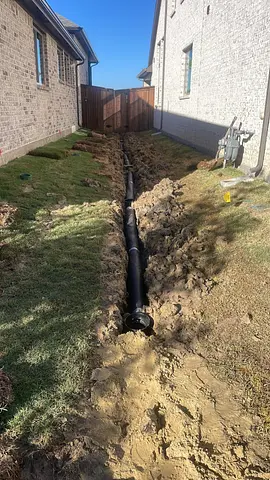
Drainage pipe installation on a North Texas property
One more reason not to live with it

Standing water is not only a nuisance

Mosquitoes, in about a week

Standing water can produce adult mosquitoes in as little as four days, which is why the standard public health advice is to eliminate it weekly. A low spot that holds water for more than about a week between rains is a breeding site, not just a wet patch.

Grass will not grow there

Turf roots need air as well as water. Ground that stays saturated suffocates them, which is why the same low spot is bare or thin year after year no matter how much seed goes into it. It is also where nutsedge and brown patch turn up.

It gets worse, not better

Water moving across bare soil carries it away, so the low spot deepens each year and collects a little more. Left alone, a small dip becomes a genuine problem, and the fix gets larger with it.

Water sitting where it should not?

We grade, install surface and subsurface drainage, and tie downspouts into buried lines — across the Metroplex since 1995.

FAQs

Drainage questions we get asked

Why does my yard drain fine sometimes and flood other times?

Because blackland clay behaves as two different soils. Dry and cracked it takes water fast, straight down the cracks. Once it has wetted up and those cracks have swollen shut, it takes water at a small fraction of the rate a storm delivers it. Same yard, same rainfall, completely different result depending on what the preceding fortnight was like.

Do I need a French drain?

Less often than people think. A French drain is for water moving through the soil. If your problem is water standing on the surface after a storm — which it usually is here — regrading and surface drains piped to daylight will normally do more, for less. The question to answer first is where the water is, not what to install.

Will a dry well or a soakaway work?

Realistically, no. They need the surrounding soil to accept water at roughly a third of an inch an hour; wet blackland clay manages around six hundredths. It becomes a buried tank with no way of emptying except evaporation. Water has to be taken somewhere on this ground, not put into it.

How far should my downspouts discharge?

At least five to ten feet from the building, or tied into an underground line that takes the water further. And it has to land somewhere that then drains away — an extension that discharges onto flat clay two feet from where it started has not achieved much.

My neighbour raised his yard and now I flood. What can I do?

Texas law prohibits diverting or impounding the natural flow of surface water in a way that damages someone else’s property, and gives the damaged owner remedies including having the work altered. In practice, start with a conversation, photographs taken during a storm, and your plat — and if it is serious, that is a question for a Texas attorney rather than for us.

Is standing water really bad for my foundation?

Yes, and the mechanism is worth understanding. It is not moisture as such — it is uneven moisture. Engineering guidance on expansive clay is about keeping conditions uniform round the whole house. Water ponding at one edge is the opposite of uniform, and on cracked clay it travels straight down to the bearing soil.

Do I need a permit?

Cities differ, so ask yours. Dallas exempts residential storm water drains; Fort Worth runs a grading permit process. Regardless, exemptions will not cover a retaining wall over four feet, work inside a recorded drainage easement, or anything in a floodplain.

How do I know it is drainage and not a leak?

Turn the irrigation controller off for a week. If it dries out, it was the sprinklers. If it does not, read the water meter with everything off and again two hours later — movement means a pressurised leak. No movement and a spot that still never dries suggests something that is not under pressure, such as a sewer line, which needs a licensed plumber.

Let’s talk

Get an estimate

Tell us where the water sits and how long it stays. Photographs taken during or just after a storm help more than anything else.

Prefer to talk? Call (972) 240-8082, Monday to Friday, 8:00 AM to 5:00 PM.