Irrigation Types & Grass Basics

What is in your yard, what it is for, and how to stop guessing at the controller.

Yard Smarts guide

There is no such thing as the right number of minutes

The most common question we get is how long somebody should run their sprinklers. There is no answer to it in the abstract, because five things change it: what grass you have, what is spraying it, what your soil is, how much sun that area gets, and what month it is.

Two zones on the same controller, in the same yard, can legitimately need run times that differ by a factor of three. Setting them all to the same number — which is what most controllers are left doing — guarantees that some of the yard is drowning while the rest is dry.

This guide is about understanding what you are looking at. For the calendar and your city’s rules, see the DFW watering guide.

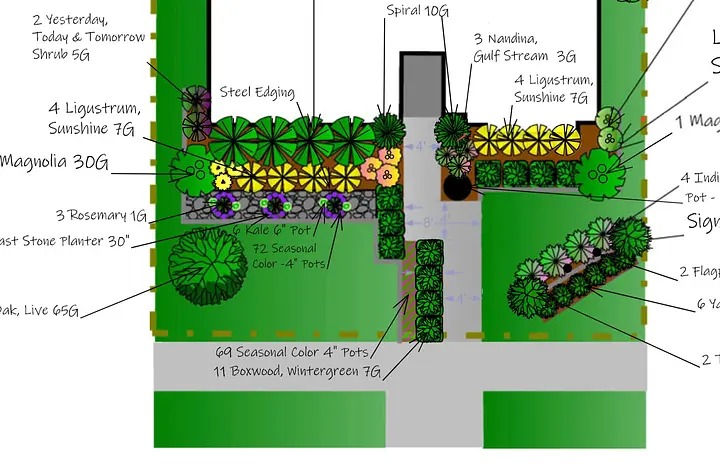
Irrigation design plan showing zone layout
Know your hardware

The types of irrigation, and what each is for

Walk out and look at what pops up. It tells you more about your watering problem than any schedule will.

Fixed spray heads

Pop-up heads throwing a fixed fan of water roughly 4 to 15 feet. They apply water fast — several times faster than the ground can absorb it here — so they need short run times, split into cycles. Best on small and regularly shaped turf areas.

Rotors

Heads that rotate one or more streams across 20 to 45 feet or more. They apply water far more slowly than sprays, so they need much longer run times to put down the same amount. Right for large open turf.

Rotary nozzles

Multi-stream rotating nozzles that fit onto ordinary spray bodies. They apply water slowly like a rotor while covering a spray-sized area, which makes them excellent on slopes and in wind — and they are the most common worthwhile retrofit on an older system.

Drip

Tubing with emitters that release water slowly at the root zone, under the mulch. Very little is lost to evaporation or wind. This is what belongs in shrub beds, hedges and around trees — not spray.

Bubblers

Low heads that flood a basin around a tree or large shrub. Good for getting water deep at an individual plant rather than across an area.

Subsurface drip

Dripline buried beneath turf. Useful for narrow strips, awkward shapes and windy exposed areas where spray would mostly water the pavement.

The one rule that matters most: never mix head types on a zone.

A spray head can put down water several times faster than a rotor. Put both on the same zone and there is no run time that is correct — whatever you set, the spray area floods or the rotor area starves. If you have a zone with both, that is a design fault worth correcting, not a scheduling puzzle to solve.

Zones

What a zone is supposed to be

A zone should group areas that want the same amount of water at the same time. Four things decide that.

1Turf or bed

Grass and shrubs want completely different amounts on completely different schedules. Sharing a zone means one of them is always wrong — and it is usually the beds being drowned.

2Sun or shade

A shaded lawn area can need a fraction of what the same grass needs in full sun. Running them together is the classic cause of a soggy, fungal patch under a tree.

3Head type

Sprays, rotors and rotary nozzles apply water at very different rates. Each needs its own zone to be scheduled honestly.

4Slope

Water runs off a slope before it soaks in, so sloped areas want shorter, more frequent cycles than flat ground, and often benefit from rotary nozzles.

Know your grass

The four grasses worth planting in North Texas

Shade tolerance is the decision that matters most here, and it is the one people most often get wrong.

GrassShade toleranceWater needMowing heightWear toleranceBest suited to
BermudagrassVery lowModerate1–2.5 inHighFull-sun lawns, play areas and anywhere that takes a beating. Recovers fast from damage, but thins to nothing in shade.
St. AugustineHighModerate2.5–3.5 inLowThe shade-tolerant choice, and very common here. Watch for chinch bugs in hot dry summers and brown patch in cool damp autumns.
ZoysiaHigh to moderateModerate1–3 inHigh to moderateDense and fine-textured, handles some shade and some traffic. Slow to recover once damaged, so it rewards patience.
BuffalograssVery lowVery low3–8 inLowA true prairie native and the lowest-water turf on this list. Full sun only, and not for a yard that gets walked on hard.
Characteristics per Texas A&M AgriLife Water University turfgrass selection guidance for North Texas.
If grass will not grow under your tree, it is a light problem.

Bermuda and buffalograss have very low shade tolerance — no amount of water or fertiliser changes that. The honest options are a shade-tolerant grass and lower expectations, a shade bed with plants that want those conditions, or synthetic turf.

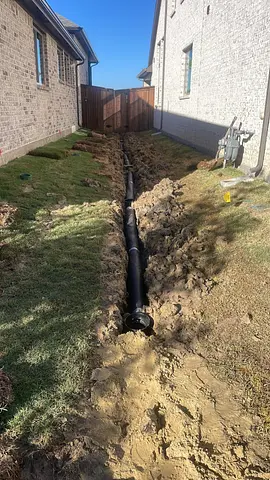
Trench and pipework in North Texas clay soil
Know your soil

Blackland clay changes everything

Most of this region sits on heavy blackland clay. It holds moisture well once it has it — which is good — but it accepts water very slowly, which is the source of most watering frustration here.

A spray head applies water several times faster than clay can absorb it. So a single long run does not water deeply; it waters briefly and then sends the rest down the driveway. The fix is not fewer minutes, it is the same minutes split into two or three cycles with a gap between them for the water to move in. That one change fixes more dry lawns than any product.

Clay also swells and shrinks with the seasons, which is why heads end up tilted and buried, and why lateral lines shear. If you are fixing the same spot repeatedly, the soil is telling you something.

Irrigation repair →

Putting it together

Building a schedule that fits your yard

1Identify the grass

Look at the blade. Coarse and broad with a boat-shaped tip is St. Augustine; fine and dense is bermuda or zoysia. It sets your mowing height and your shade expectations.

2Walk the zones and note the head type

Sprays, rotors or rotary nozzles — zone by zone. Write it on a chart taped inside the controller door. This alone puts you ahead of most homeowners.

3Measure what each zone actually applies

Set a few straight-sided cans — a tuna tin is the classic — around a zone, run it fifteen minutes, and measure the depth. Now you know that zone’s rate rather than guessing it.

4Work out the run time from the rate

If a zone applies a quarter inch in fifteen minutes and you want half an inch, that is thirty minutes — but not in one go on clay.

5Split it into cycles

Two or three shorter cycles with a break between them lets the water move into the soil instead of onto the pavement. Most modern controllers do this for you if you ask them to.

6Treat shade zones separately

Shaded turf can need substantially less than the same grass in full sun. If it shares a schedule with a sunny zone, it is being overwatered every week.

7Change it with the season, and check monthly

The single biggest saving available to most households is simply not running an August schedule in October. Walk the zones once a month with the system on.

Month-by-month calendar and your city’s rules →

The most common mistake

How to tell you are overwatering

More water does not make a stronger lawn. It makes a shallow-rooted one that needs even more water.

Water on the pavement

Runoff during a cycle means you are applying faster than the ground can take it. Cycle and soak, do not cut the total.

Spongy ground and shallow roots

If a screwdriver pushes in easily hours after watering and the turf peels up with short roots, the lawn has never had to reach down.

Fungus and brown patch

Constantly damp foliage, especially in shade and in cool damp autumn weather, is an invitation to disease no fungicide will out-run.

Mosquitoes and standing water

Areas that stay wet between cycles are usually being overwatered, badly drained, or both.

A summer bill that jumps

A stuck valve or a leaking mainline shows up on the bill before it shows up in the yard. Read the meter with everything off.

Weeds thriving in the lawn

Many of the weeds that take over a North Texas lawn prefer conditions wetter than the grass does. Persistent weed pressure in one area is often a watering signal.

Want somebody to just set it properly?

We audit systems zone by zone, correct coverage, and programme the controller to the yard you actually have.

FAQs

Irrigation and grass questions

How do I know what grass I have?

Look closely at a single blade. St. Augustine is coarse and broad with a rounded, boat-shaped tip and runs above ground on thick stolons. Bermuda is fine and wiry and spreads aggressively. Zoysia is fine but noticeably dense and stiff underfoot. Buffalograss is fine, soft, grey-green and thin.

Should I water every day?

No. Frequent shallow watering builds a shallow root system that cannot cope with heat. Fewer, deeper waterings train roots down, which is what makes a lawn survive August. It is also what most city ordinances require anyway.

Is drip worth putting in existing beds?

It is usually the single best return on an older system. It cuts the water a bed needs substantially, stops overspray onto fences and brick, keeps foliage dry, and lets beds run on their own schedule instead of the lawn’s.

What are rotary nozzles and should I switch?

They are multi-stream rotating nozzles that screw onto existing spray bodies and apply water much more slowly. On slopes, in wind, and anywhere you get runoff, they are usually a worthwhile change — but the run times have to be lengthened to match, or the zone ends up dry.

How often should I check the system?

Once a month through the growing season, with the system running, walking every zone. Most of what we get called out for would have been caught in a five-minute walk.

Can you just come and set it up?

Yes — that is a normal service call. We audit the system zone by zone, correct coverage and pressure, fix what is broken, and programme the controller for the grass, soil and light you actually have. Irrigation repair and service →

Let’s talk

Get an estimate

Tell us what the system is doing and what the lawn looks like. We’ll follow up to discuss next steps.

Prefer to talk? Call (972) 240-8082, Monday to Friday, 8:00 AM to 5:00 PM.