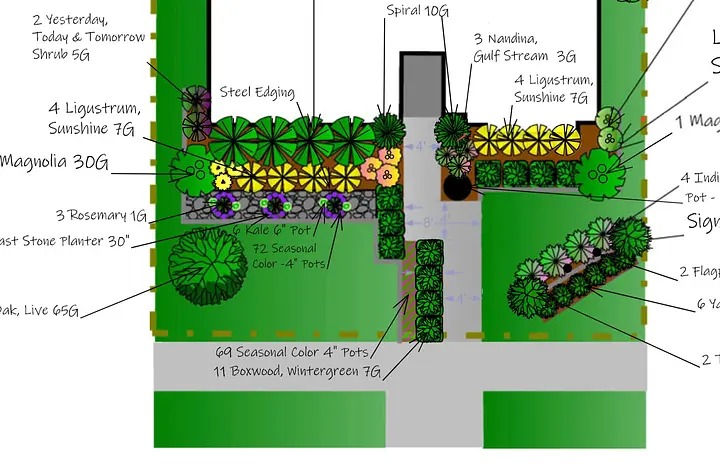
Irrigation and landscape work in Tyler, Texas — on Piney Woods sand rather than blackland clay.
We should be straight about two things before anything else. Tyler is about eighty-seven miles from our yard in Rockwall, roughly an hour and three quarters each way — so for Tyler we take installation, renovation and larger projects rather than single-head service calls. And Tyler is genuinely a different place to irrigate. It is not the Blackland Prairie.
Smith County sits in the Piney Woods on Claiborne Group sands. The dominant soils — Darco, Bowie, Cuthbert — are sandy loams and loamy fine sands, some with a sandy surface layer four to six feet deep before you reach anything that holds water. Darco is somewhat excessively drained with rapid permeability through that sand. So the failure mode is the exact opposite of clay: instead of water running off before it soaks in, water keeps going down past the roots. Long soak cycles are wrong here. Short and frequent is right.
It changes the rest of the conversation too. Shrink and swell is not the design driver it is in Rockwall, so the foundation-watering ring that is close to standard on blackland clay is not the same discussion. But Cuthbert soils sit on side slopes of eight to twenty-five per cent with only twenty to forty inches over sandstone, so you can still get real runoff and hit rock shallow — on a sandy site. Tyler gets around forty-four inches of rain a year against Dallas’s thirty-six, the soils are acid rather than alkaline, and the plant palette reflects it. This is azalea and pine country, not a clay-and-cedar-elm town.
Request an estimate

Tyler is East Texas, not the Metroplex — deep sand, pines, and eight more inches of rain a year. Almost none of our blackland advice applies.
A schedule that works on blackland clay leaches straight through Tyler sand. Shorter, more frequent cycles keep water in the root zone; long soaks feed the water table.
Deep Darco sand, deep well-drained Bowie, and Cuthbert on steep side slopes with rock at twenty to forty inches. They want different run times and different drainage answers.
Sandy does not automatically mean no runoff. On the steeper slopes, medium to high runoff over shallow sandstone is normal and needs designing around.
Tyler’s recent watering guidance has been about maintaining system pressure rather than reservoir scarcity, and restrictions here have historically appeared for treatment plant reasons even in wet years.
Tyler Water Utilities runs its own supply — Lake Tyler and Lake Tyler East, which the city owns, plus rights in Lake Palestine and about four per cent from deep wells. The city has published a recommended twice-weekly schedule (even-numbered addresses Sundays and Thursdays, odd-numbered Saturdays and Wednesdays, before 10am or after 6pm), framed as voluntary and aimed at maintaining system pressure rather than at drought. Tyler’s development code carries its own irrigation standards beyond the state rules: a master valve is required on the discharge side of the backflow device on all new installations, rain and freeze sensors are required, and a licensed irrigator or irrigation technician must be on site at all times during installation. Note that Tyler restrictions have appeared at short notice for treatment plant reasons in the past, so check the city before assuming.
Under Texas Commission on Environmental Quality rules, selling, designing, installing, altering, repairing or servicing an irrigation system requires a TCEQ licence. Ask any contractor for their license number before work begins — in Tyler as anywhere else in Texas.
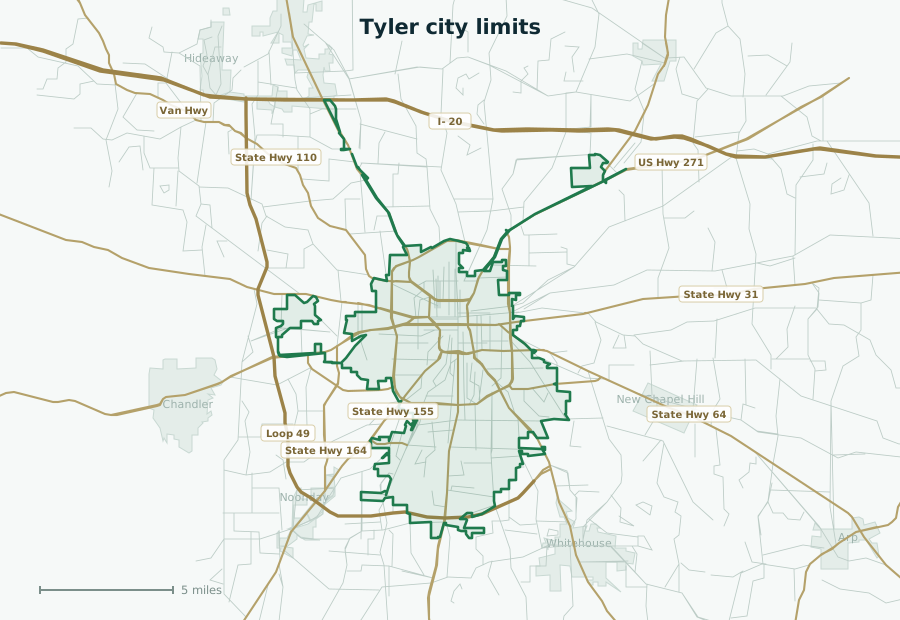
Loads an interactive map from Google. Nothing is requested from Google until you tap it.
Leaks, broken heads, valves, wiring and controllers.
Learn more →New systems designed zone by zone for your property.
Learn more →French drains and grading that move water off the slab.
Learn more →Protect pipes, valves and backflow before a hard freeze.
Learn more →Already a customer? Submit a service or warranty request →
Tell us what the system is doing and we’ll get you scheduled.
Tell us about your property in Tyler and what the system is doing. We’ll follow up to discuss next steps.
Prefer to talk? Call (972) 240-8082, Monday to Friday, 8:00 AM to 5:00 PM.